In this issue
34 articles: 10 features and columns, 17 news, 7 regulation.
Features and columns · 10
February markets absorbed shock after shock yet, on the surface at least, refused to buckle. As a whole, global equities held firm, with the notable exception of the Nasdaq, while commodities rose amid escalating tensions in the Middle East (see market review).
Fresh data show that fundraising continues to trend downward. According to Pitchbook’s latest Global Private Market report, private-equity capital fundraises hit a seven-year low of $414 billion in 2025. In fact, PE funds accounted for just one-third of all private-capital raised, the report showed, compared with 41 percent in 2024.
Much like the British weather, it’s been raining submissions for AIMA’s UK advocacy team in 2026. This surge in consultations is timely. The UK government and its financial watchdog, the Financial Conduct Authority (FCA) have recently brought several key proposals to the forefront, each offering a chance to enhance the country's competitiveness at a crucial moment for economic growth.
Middle Eastern sovereign wealth funds have quietly become the center of gravity in global state capital and 2026 is already showing that the real action is shifting from deal rooms to boardrooms.
In an interview with Simon Brewer on The Money Maze Podcast, Soraya Chabarek, President & CEO of Manulife | CQS Investment Management, sets out a leadership philosophy forged in hedge fund intensity, credit market cycles and a deep belief in people. Her remarks are candid, self-aware and consistently anchored in one core idea: progress comes from the “pursuit of the possible”.
Crypto’s early private markets were defined by access. Capital flowed to those closest to networks, protocols, and information asymmetries. Innovation outpaced structure, and participation was often driven by opportunity rather than underwriting discipline. Today, the defining shift in crypto private markets isn’t broader access or technological novelty, but accountability.
If a finance team mistakenly wires $1m to the wrong bank account, that money is not gone. There are established remedies, counterparty and legal frameworks designed to unwind the error. In a decentralised blockchain system, that safety net does not exist. Once a transaction is signed and broadcast, the funds are final.
Private markets have long been the lifeblood of growth-stage and mid-size businesses looking to scale. Private equity alone saw $2.6 trillion in deal value globally in 2025, up by almost a fifth on the year before. Yet while private markets are seeing a resurgence, their infrastructure still belongs to a bygone era.
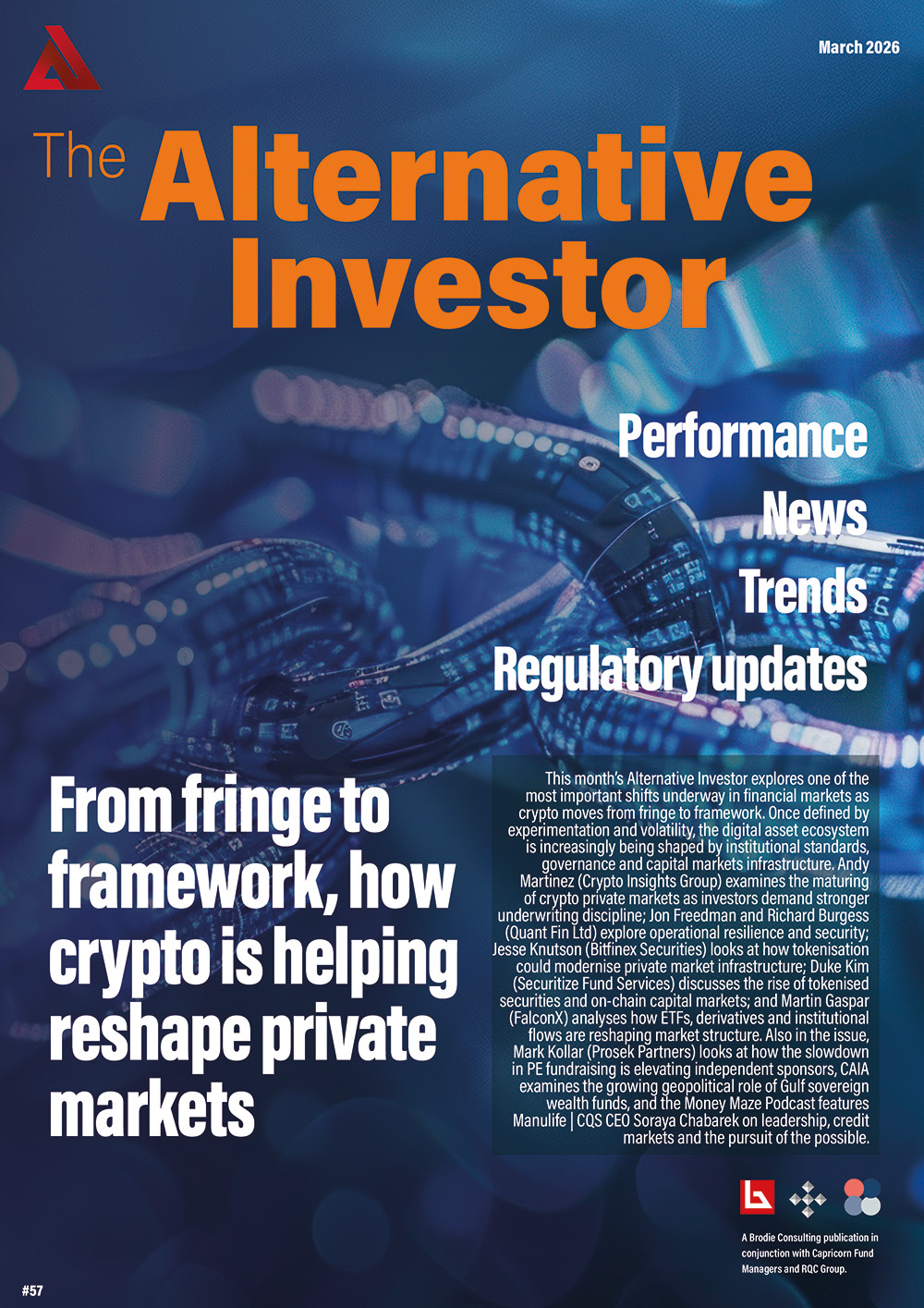
“Crypto” has historically been shorthand for volatility and speculation, or worse. Institutional participants have previously sought to separate the technology from the emerging asset class; i.e., “blockchain not crypto”. And now, the technology and its blockchain-based assets have converged and emerged as an integral part not just of onchain capital markets, but simply, capital markets.
Bitcoin ETF volumes have climbed to roughly 50% of BTC spot volumes in recent weeks, a sign of how quickly the market's structure has shifted. Crypto trading, once dominated by spot exchanges, now runs through instruments long familiar to traditional finance: ETFs and a rapidly growing derivatives complex.
News · 17
Amid concerns about private credit and slowdown in inflows, London-based Arcmont Asset Management secured €1.5 billion for its second Capital Solutions fund, nearly double that of its predecessor. This fund targets opportunities across junior capital, structured equity, secondaries and bespoke refinancing situations. More than half has already been deployed across 20+ investments.
HGGC closed its fifth flagship private equity vehicle, HGGC Fund V, at $3.2 billion, exceeding the $2.8 billion hard cap. This fund has already invested in Equity Methods, Sterling Brokers, Inspired PLC and Centralis Group. Founded in 2007 and headquartered in Palo Alto, HGGC focuses on the middle-market technology, business services, financial services and consumer sectors.
Showing there is continued interest in tech, Novacap closed its Technology Fund VII at $3.8 billion, exceeding the $2.75 billion target. The fund was raised in under a year, an impressive achievement for the Montreal-based manager. The new vehicle is roughly double that of its predecessor, Technology Fund VI, which closed at $1.9 billion.
JLL Partners closed its ninth private equity vehicle, JLL Partners Fund IX, raising $1.4 billion for healthcare, industrial and business services. Building on more than three decades of experience, the firm focuses on operational improvements, strategic acquisitions and organic growth, with a particular onus on complex middle-market situations.
Partners Capital closed Merlin IV with over $1 billion in capital, targeting co-investments alongside private equity sponsors in single-asset buyouts across global markets. This close follows Goldman Sachs’ recent $2.8 billion raise for its fourth private equity co-investment vehicle.
Kinterra Capital closed Critical Materials & Infrastructure Opportunities Fund II at $950 million, exceeding the $850 million target and reaching its hard cap on an accelerated timeline. The fund focuses on upstream critical minerals viewed as essential to energy transition and resilient supply chains.
Demonstrating that track record and brand remain crucial to attracting capital, Veritas Capital completed the month’s standout $15.3 billion fundraise for the Fund IX strategy and related vehicles. This is a significant uptick on its predecessor, Fund VIII, which closed at $11 billion in 2019, and again underscores continued investor appetite for established platforms.
Blue Owl Capital raised more than $3 billion for its latest strategic equity and secondaries vehicle. The fund invests in GP-led continuation vehicles and structured liquidity solutions, reflecting sustained institutional demand for such investments.
Azora secured nearly €1 billion at the third close of its Southern European Opportunities III vehicle, making it the largest real estate fund dedicated to Southern Europe to date. The strategy focuses on Spain, Portugal and Italy, targeting value-add and opportunistic investments across living, hospitality, logistics and alternative real estate segments.
Paris-based Tikehau Capital closed its second vintage private debt secondaries fund above target with over $1 billion in commitments. Focused on seasoned private equity portfolio and fund interests, Tikehau’s secondaries business is still a relatively small but fast-growing vertical within its business.
Vision Ridge Partners raised $2.4 billion for its latest sustainable infrastructure vehicle, Sustainable Asset Fund IV, targeting investments across environmental and climate-transition assets. Headquartered in Boulder, Colorado, the firm focuses on climate-aligned strategies across renewable power, water infrastructure, sustainable transportation and resource-efficiency platforms.
Anton Levy raised $1 billion for his debut independent private equity vehicle. Levy, former senior partner at General Atlantic, is targeting growth-oriented investments across technology, services and consumer sectors, leveraging decades of experience in scaling founder-led and high-growth businesses.
We have long made the case that acquiring assets and established teams is often more effective than building strategies organically. One River Asset Management clearly thinks so, having acquired LGT Capital Partners’ Quantitative Investment Solutions unit. The deal adds over $900 million in AUM, taking the Greenwich, CT-based manager’s total assets to approximately $3 billion.
The $9.9bn acquisition of Schroders by Nuveen, the asset management arm of TIAA, marks one of the most significant consolidations in European asset management in recent years…
Is Man Group an alternative manager, a long-only manager, or something in between? The firm’s latest results suggest the answer increasingly lies somewhere in the middle.
Victory Capital has thrown a significant spanner into the works for Nelson Peltz’s planned acquisition of Janus Henderson Investors, tabling a fully financed rival proposal that threatens to upend the existing agreement backed by Trian Fund Management.
London Stock Exchange Group is facing intensified pressure from activist investor Elliott Investment Management, which disclosed a significant stake and is pushing for further strategic action. The move follows LSEG’s announcement of a £3 billion share buyback, alongside margin improvement targets and clearer articulation of its AI and data strategy.
Regulation · 7
The FCA has updated its webpage that sets out good practice and areas for improvement for Consumer Duty board reports. The updates provide additional insight on how smaller firms can meet the requirements.
On 12 February 2026, HM Treasury launched a consultation canvassing views on its proposals to revise the Appointed Representatives’ (“AR”) legislative framework. Following prior regulatory activity, notably HM Treasury’s August 2025 Policy Statement, this regime has been on the regulators’ radar for some time.
On 17 February 2026, the FCA launched a consultation, CP26/6, on proposed changes to the UK securitisation rules, including to simplify the due diligence and transparency requirements. The Prudential Regulation Authority also launched CP2/26, Reforms to securitisation requirements.
The FCA has published a webpage setting out examples of good and poor practice when using labels under the Sustainability Disclosure Requirements (“SDR”) regime. Implemented in 2024, the labelling regime is a voluntary framework that seeks to improve transparency and equip consumers with information to navigate the market.
On February 24 2026, the US Securities and Exchange Commission (“SEC”) released significant revisions to its Enforcement Manual, marking the first comprehensive update in nearly a decade and establishing a new expectation of annual reviews going forward.
On January 28, 2026, the SEC’s Divisions of Corporation Finance, Investment Management, and Trading and Markets issued a joint statement providing clarity on the taxonomies associated with tokenised securities, and how existing federal securities laws apply to them.
On February 25 2026, the SEC announced settled charges against an Illinois-based formerly registered investment adviser for selling loans to private fund clients (“the Funds”) without reasonably assessing whether those trades were at fair market value.
Receive The Alternative Investor each month, with news and features from across private capital.
Subscribe