June 2025
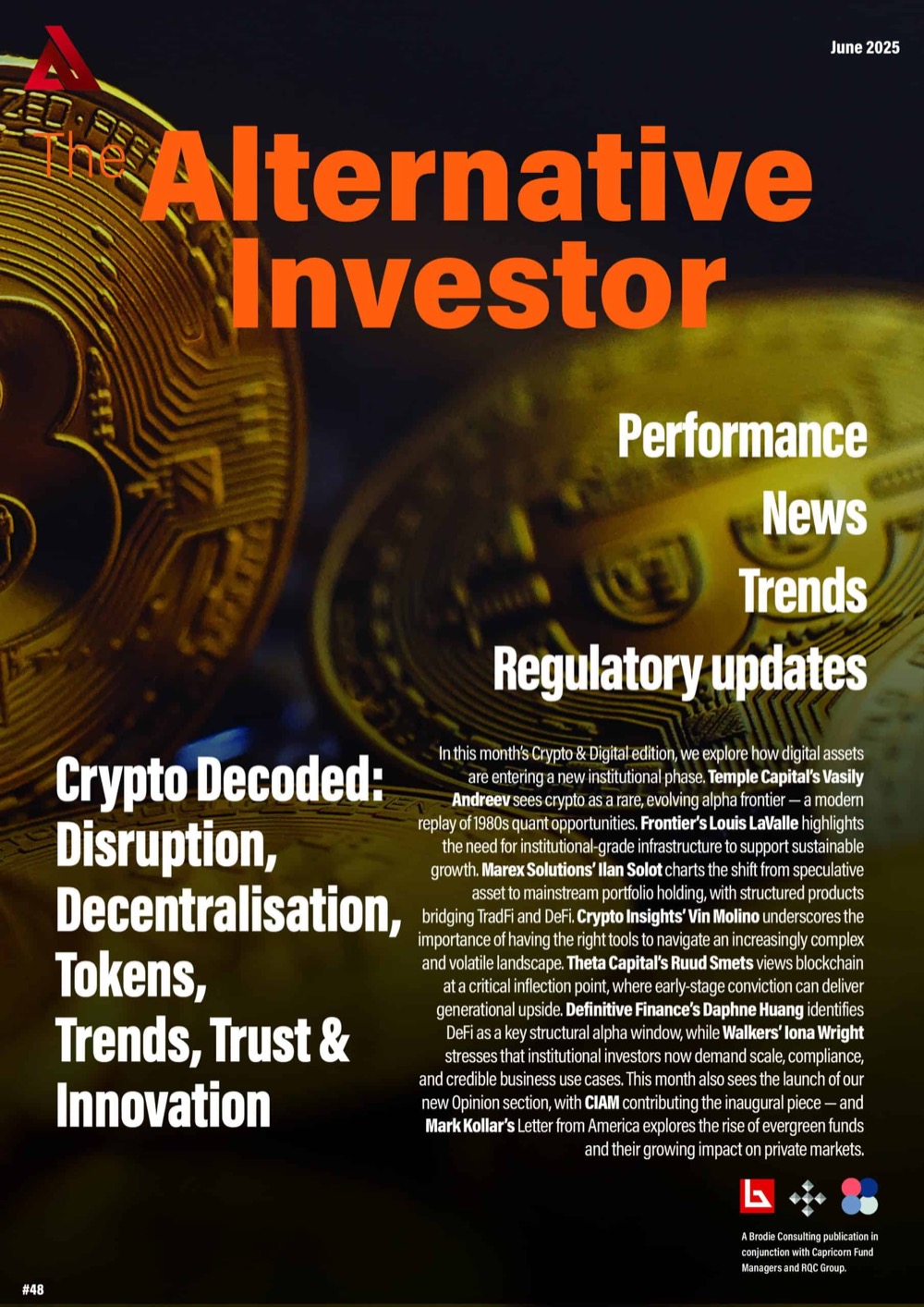
Crypto Decoded: Disruption, Decentralisation, Tokens, Trends, Trust & Innovation
Read the issueIn this issue
32 articles: 10 features and columns, 19 news, 3 regulation.
Features and columns · 10
Looking back at May, geopolitics remained a central driver of market sentiment, with fresh uncertainty stirred by high-profile diplomacy and fiscal manoeuvring from President Trump. In this environment, most hedge fund strategies, except macro, had a strong month. The HFRI Fund Weighted Composite Index rose 2.0%, taking year-to-date performance to 1.3%.
Active fund management plays a crucial role in ensuring that financial markets function efficiently and responsibly. While passive investing has experienced explosive growth due to its low costs and simplicity, an overreliance on passive or systematic strategies could threaten the integrity of market pricing, corporate governance, and investor protection.
In perpetuity is a term not often considered part of the private-equity lexicon, but a certain type of fund that has been around for 20 years by some counts is making headlines lately and gaining the attention of investment managers looking to attract the retail investor. Enter the evergreen fund, an open-ended structure that provides GPs and LPs alike with flexibility and liquidity.
If you could go back to Wall Street in the 1980s, with the data science toolkit of today, you would have a good chance of crushing the markets. While traditional markets have matured and become increasingly efficient, crypto markets, especially in perpetual futures on Bitcoin and Ethereum, offer a new type of alpha for systematic trading.
Bitcoin has recently surged to a new all-time high above $111,000. That headline alone speaks volumes: crypto is no longer on the fringe, it is now part of the normal financial discourse amongst asset managers and the media. The asset class once dismissed as speculative has emerged stronger, with deeper liquidity, institutional credibility, and expanding use cases.
Over the past five years I have met hundreds of crypto hedge fund managers. The talent is real. What is missing is the infrastructure to support it. Until that changes, most of the industry will remain subscale and structurally off-limits to institutional capital. More than 80% of crypto hedge funds manage under $50 million.
Bitcoin is moving up, regulatory obstacles appear to be moving down, but the experience of digital asset investing can still be disorientating. The current marketplace for crypto investment products now offers a number of flight path options to consider when building an allocation, from venture funds to hedge funds, ETPs and crypto-yield products.
In investing, some windows only open once. By the time a transformational technology reaches public consensus, the asymmetry is gone. Blockchain today stands at a similar inflection point, in what we call the zero-to-one moment, when foundational rails are being laid: decentralized finance protocols, zero-knowledge cryptography, real-world asset tokenization and Ethereum scaling layers.
As digital assets mature, a new frontier of opportunity has emerged in decentralized finance, where sophisticated players are able to capture outsized returns. Alpha is now greatest in DeFi markets, with many new token assets launching and trading billions in volume onchain before ever being listed in centralized finance.
The digital assets market has seen unprecedented growth, particularly in the last 18 months, and a recent report by Boston Consulting Group and Ripple does not see this slowing down. They predict tokenised real-world assets will grow at a compound annual growth rate of 53% from 2025 to 2033, reaching $18.9 trillion from $600 billion today.
News · 19
Thoma Bravo set a new benchmark in tech fundraising, announcing a $34.4 billion raise across its latest flagship funds, including Fund XVI, which closed at $25 billion, the largest tech buyout fund ever. Discover Fund V and Explore Fund III rounded off the raise, which continues the focus on high-growth software companies in cybersecurity, healthcare IT and fintech.
New York-based Blue Owl Capital closed its third flagship digital infrastructure fund, Blue Owl Digital Infrastructure Fund III, with $7 billion in total capital commitments, significantly above the original $4 billion target. The fund targets the acquisition, development and operation of large-scale, build-to-suit data centres and digital infrastructure assets.
Pioneer Point Partners announced the final close of its second sustainable infrastructure fund, Pioneer Infrastructure Partners II, at EUR 1.1 billion. The fund invests in infrastructure sectors supporting the energy transition and environmental sustainability, with capital predominantly deployed in Western Europe.
Northleaf Capital Partners hit the hard cap for its flagship infrastructure vehicle, Northleaf Infrastructure Capital Partners IV, at $2.6 billion. The fund focuses on mid-market, contracted infrastructure assets, namely energy transition, digital infrastructure and transportation, and has completed five investments to date.
Texas based Crestline Investors closed two major private credit funds, raising $5.2 billion. Its flagship direct lending vehicle, Crestline Direct Lending Fund IV, secured $3.5 billion to target North American middle-market borrowers, while the firm raised $1.7 billion for its Portfolio Finance Sentry Fund, focused on NAV-based lending to private equity and asset managers.
Antares Capital closed its first private credit continuation vehicle, raising over $1.2 billion in a deal led by the Credit Secondaries funds of Ares Management. The vehicle acquired assets and LP interests from two Antares-managed funds, spanning more than 100 senior floating-rate loans, and marks the largest credit secondary investment by Ares to date.
D.E. Shaw Group raised $1.3 billion for its second Capital Optimization Fund, Diopter Fund II, which focuses on private credit investments. The fund acquires credit risk transfer assets, including synthetic securitisations, enabling banks to optimise their capital and manage risk more effectively.
Kayne Anderson Capital Advisors closed its third flagship energy fund, KPEIF III, at $2.3 billion, above its $1.5 billion target. The largest energy vehicle raised by the firm continues its strategy of investing in private energy companies with large-scale oil and gas assets generating stable cash flow.
TPG is on the road marketing its latest flagship buyout fund, TPG Partners IX, targeting $13 billion, slightly below the $14.2 billion raised by its predecessor in 2019. The fund will continue the strategy of investing in large-scale, control-oriented buyouts across healthcare, technology, financial services and consumer.
VMG closed its sixth fund, VMG Partners VI, at $1 billion, surpassing the $850 million raised for its previous fund in 2021. The new vehicle continues the strategy of backing high-growth, primarily North American, founder-led consumer businesses across food and beverage, wellness, beauty, fitness and pet care.
Singapore-based healthcare private equity firm Quadria Capital announced the final close of its third fund at $1.1 billion, comfortably above its original $800 million target. The fund includes $954 million in primary commitments and $114 million in co-investment capital, with an additional $300 million expected during deployment.
JPMorgan Chase passed the $1 billion marker for its Private Markets Fund I, which it launched in 2023 to provide high-net-worth individuals with access to private equity opportunities. The fund focuses on secondary transactions and co-investments, and reflects the growing demand from affluent investors for broader exposure to alternative assets.
Blackstone Strategic Partners acquired a $5 billion private equity portfolio from the five public pension systems of New York City, including the Teachers Retirement System, in one of the most significant secondary transactions to date. The sale encompassed over 125 fund interests from 74 managers and was driven by a strategic realignment rather than liquidity needs.
Legal & General took a 75% stake in Proprium Capital Partners, the global real estate private equity firm managing $3.5 billion in assets. The development comes as it looks to grow its private market platform from £50 billion to £85 billion by 2028, and enhances its capabilities in real estate, infrastructure and private credit.
iCapital acquired Citi Global Alternatives, transferring management of over 180 alternative investment funds. The deal includes private equity, credit, real estate, infrastructure and hedge funds, with Citi remaining the distributor of these funds and iCapital providing the underlying technology and operational infrastructure.
Man Group made a series of significant US moves in recent weeks. According to Bloomberg, the firm is in advanced talks to acquire Bardin Hill Investment Partners, a New York-based credit specialist managing approximately $3.3 billion, and is strengthening its US wealth management presence with two senior hires.
Brevan Howard appointed JPMorgan executive Carlos Hernandez as its first Executive Chairman, focusing on high-level corporate strategy and client development. The move reflects the evolution of the firm into a diversified investment platform, expanding beyond its macro hedge fund roots into digital assets and global credit.
Charles Schwab launched an alternative investments platform for eligible retail investors, expanding access to a broader range of alternative asset classes. Piloted in October 2024, the platform became widely available in April 2025 to clients with at least $5 million in household assets and a minimum 30-day client tenure.
According to With Intelligence, single-family offices now control an estimated $4.7 trillion in assets. Most of this is concentrated in EMEA, with the Americas managing close to 40% of the total. Private equity stands out as the top investment focus, with over 90% of single-family offices allocating capital to the space.
Regulation · 3
On 8 May 2025, the Financial Conduct Authority published its findings from its review of business models for smaller asset managers and alternatives. The FCA supervises almost 1,000 buy-side firms with less than £1 billion assets under management, and sent a survey to 410 of these firms, with sixty then undergoing a more in-depth assessment.
On 9 May 2025, the FCA finalised the rules that allow fund managers to pay for investment research using a joint payment option for research and execution services. The rules took effect immediately and are based on those introduced for MiFID investment firms in August 2024.
In a case that highlights the powers of the regulator to effectively shut down a business, the FCA on 2 May 2025 announced that on 27 March 2025 it had placed restrictions on Direct Trading Technologies, restricting access to its assets and preventing it from carrying on any regulated activities.
Receive The Alternative Investor each month, with news and features from across private capital.
Subscribe