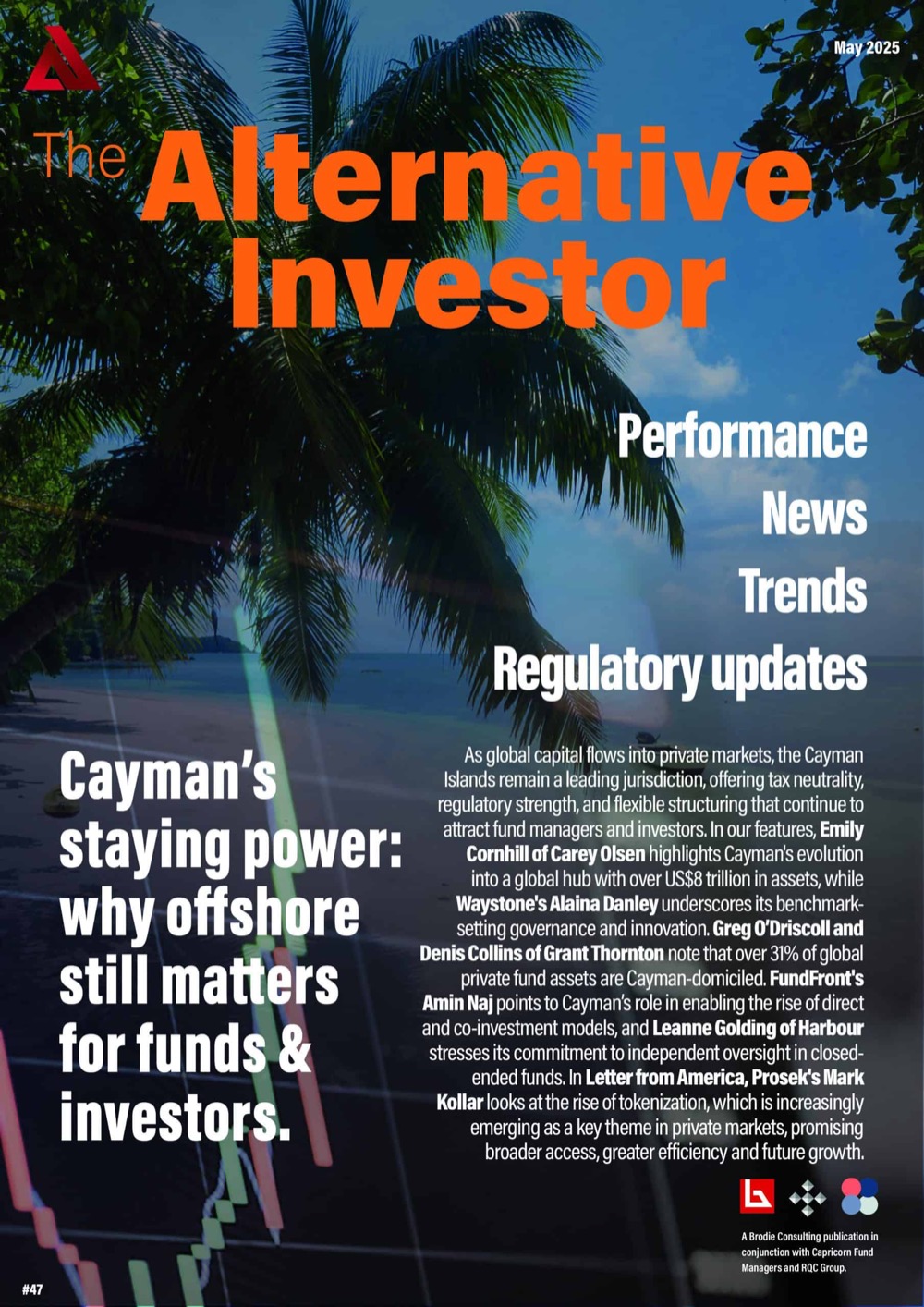
May 2025
Cayman Insights – Uncover key trends shaping private markets from the heart of offshore finance
Read the issueIn this issue
32 articles: 7 features and columns, 19 news, 6 regulation.
Features and columns · 7
April was marked by geopolitical flashpoints and a dramatic escalation in protectionism, notably President Trump's sweeping new import tariffs. These developments triggered a sharp global market sell-off, posing a significant challenge for hedge fund managers, one they navigated reasonably well, with the HFRI Fund Weighted Composite Index down just 0.5%.
Fresh off the Milken Institute Global Conference in Beverly Hills, it is safe to say that focus from the main stage hardly strayed from the direction of tariffs, taxes and deregulation. That is exactly the backdrop that has made the concept of tokenization not so much center stage but a talking point among alts circles.
Over the past 25 years, the Cayman Islands have established themselves as a leading jurisdiction for alternative investment funds, with nearly 13,000 regulated open-ended funds and over 17,000 regulated closed-ended funds. As at the end of 2023, registered investment funds had a combined net asset value of over US$8 trillion.
The Cayman Islands continues to be regarded as a benchmark among offshore fund jurisdictions, distinguished not only by the volume of funds but by its quality of governance, regulatory integrity and investor protections. Today, Cayman is home to over 30,000 investment funds, including hedge funds, private equity and private credit.
The Cayman Islands is often cited as the leading jurisdiction for offshore private funds, but what do the numbers say? According to the latest report from the SEC, as of Q3 2024 a remarkable 31.7% of the net assets of all private funds globally are held in Cayman Islands-domiciled vehicles.
Private markets are entering a new era, marked by a decisive shift away from traditional blind-pool investing toward more agile, transparent and collaborative models. At the center of this evolution is the rise of direct investing and co-investment structures, and increasingly the jurisdiction making it all possible is the Cayman Islands.
As investors expand their search for alpha and seek returns in less liquid strategies, closed-ended investment funds are increasingly popular. Alongside this shift, regulators and investors alike are demanding enhanced fund governance, pushing for higher standards across all fund structures.
News · 19
EQT's BPEA Private Equity Fund IX held its first close with over $10 billion in commitments, putting it on track to meet the $12.5 billion target and $14.5 billion hard cap later this year. Launched in August 2024, the fund is the largest Asia-focused vehicle of the firm to date, continuing the strategy of its $11.2 billion predecessor, BPEA VIII.
Apollo Global Management announced the final close of Apollo S3 Equity and Hybrid Solutions Fund I, raising approximately $5.4 billion and surpassing its initial target. The fund is part of the fast-growing Sponsor and Secondary Solutions platform, which has nearly $10 billion in total commitments since being launched in 2022.
The mid sized private credit players are seeing investor inflows, with Apera Asset Management reaching a final close of its third private debt vehicle at EUR 2.9 billion including associated vehicles and leverage. The fund focuses on senior secured unitranche financing for lower mid-market companies across Western Europe.
Crayhill Capital Management closed its third flagship fund, Crayhill Principal Strategies Fund III, with approximately $1.3 billion in capital commitments, including $162 million in co-investment capacity, surpassing the $1 billion target. The credit fund focuses on highly structured, asset-backed investments.
TowerBrook Capital Partners is preparing a new flagship private equity fund targeting $4 billion. Its previous fundraise in 2018 secured $5.3 billion across two funds. The New York and London headquartered firm, a spin-off from Soros Fund Management, is also expanding its European presence with new offices in Milan and Dublin.
Apollo Global Management launched its New Markets division, opening up access to private markets for retail investors. The division focuses on four key business lines: traditional asset management, defined contribution plans, tax-advantaged solutions and digital markets. It underscores the continued commitment of the firm to building and expanding its investor base.
KKR and Capital Group launched two new credit-focused interval funds, Capital Group KKR Core Plus+ and Capital Group KKR Multi-Sector+. The funds provide retail investors with a mix of public and private credit, with a minimum investment of $1,000 and quarterly liquidity options of up to 10% of net asset value.
Pantheon launched Pantheon Global Credit Secondaries Fund, the seventh evergreen offering of the firm for private wealth investors and the latest addition to its $10.6 billion global private wealth platform. The semi-liquid vehicle offers access to private credit secondaries through a single investment, with quarterly liquidity.
Five Arrows, the private equity arm of Rothschild & Co, closed its sixth secondaries fund, Five Arrows Secondary Opportunities VI, at EUR 2 billion, twice the size of its predecessor. The oversubscribed fund focuses on the European mid-market and is yet further evidence of where investor appetite currently sits in the private equity secondary space.
Yale University confirmed it is working with Evercore to explore a potential sale of its private equity holdings. The move, reportedly in the works for several months, will enhance liquidity amid budgetary pressures and growing scrutiny over elite university finances. While the size of the sale remains unconfirmed, some reports suggest it could reach as much as $6 billion.
Wellington Management, Vanguard and Blackstone announced a strategic alliance to develop simplified multi-asset solutions that integrate public and private markets, as well as active and index strategies. According to Bloomberg, the first product is set to be an interval fund managed by Wellington.
Pimco received informal approval from Luxembourg regulators for its first European private credit fund targeting retail investors, Pimco Diversified Private Credit Fund. The fund will focus on European asset-backed credit, including debt secured by inventory and property.
Pioneer Point Partners closed its second sustainable infrastructure fund, Pioneer Infrastructure Partners II, at EUR 1.1 billion, above its EUR 800 million target. Backed by European and North American institutional investors, the Article 9 SFDR-classified fund targets energy transition and environmental infrastructure across Western Europe.
Evidence of these challenging markets was clear in the KKR results, which showed the first Q1 net loss of the firm since 2022. This was attributed to a $1.1 billion hit in its Global Atlantic insurance unit, driven by valuation markdowns in a $76 billion fixed-income portfolio amid volatile interest rates.
Man Group reported net inflows of $3.6 billion in the first quarter of 2025, contributing to an increase in AUM to $172.6 billion as of March 31. However, the firm also disclosed a $5.6 billion assets drawdown during the first two weeks of April, bringing the total to $167 billion by April 14. The decrease was attributed to market volatility and losses in investment performance.
Millennium Management is reportedly in discussions with Petershill Partners PLC to sell a minority equity stake in its management company, in what the Financial Times describes as part of a broader strategy to institutionalise the business and prepare for leadership succession.
In an all-cash deal totalling $1.8 billion, Nomura acquired the US and European public asset management business of Macquarie Group. The deal encompasses approximately $180 billion in AUM across equities, fixed income and multi-asset strategies, and is expected to close by the end of 2025.
Affiliated Managers Group took a minority equity interest in Verition Fund Management, a global multi-strategy investment firm managing approximately $12.6 billion in assets. Under the agreement, Verition management retains a substantial majority of the equity of the firm and continues to lead the organisation independently.
Brandon Lutnick, chair of Cantor Fitzgerald, announced a partnership with SoftBank Investment Advisers, Tether and Bitfinex to launch a $3 billion bitcoin investment vehicle named 21 Capital. Using a special purpose acquisition company, the plan is to emulate the MicroStrategy strategy of leveraging equity and debt.
Regulation · 6
The FCA has published a Call for Input on the future regulation of alternative fund managers, outlining its approach to changing the regulatory framework for AIFMs in the UK. It is proposed that the current regime for categorising AIFMs will be replaced with a three tier approach based on assets under management.
The FCA has released the latest version of its biannual Regulatory Initiatives Grid, setting out planned regulatory initiatives for the next 24 months. Initiatives of relevance to fund managers include a review of the UK funds regime and adoption of the Consumer Composite Investments disclosure to replace PRIIPs.
The FCA has published a Consultation Paper proposing the removal of all references to the UK Capital Requirements Regulation from the definition of regulatory capital, or own funds, that applies to investment firms subject to the MIFIDPRU prudential framework.
The FCA has updated its webpage alerting firms to fake FCA communications. By pretending to work for the FCA, scammers are ever attempting to trick firms into revealing important information, attempting contact by email, phone or post, or using the name of an FCA employee.
The Prudential Regulation Authority announced that it had fined Mr George Jay Hambro, a former Notified Non-Executive Director of Wyelands Bank Plc, GBP 72,000 for breaching Individual Conduct Rule 2. His conduct was found to fall below the standards required of one in his position.
Recent market volatility acts as a timely reminder for private fund advisers of their obligations under the Form PF current reporting requirements of the SEC, which came into effect in December 2023. Certain events must be reported within 72 hours for large hedge fund advisers.
Receive The Alternative Investor each month, with news and features from across private capital.
Subscribe