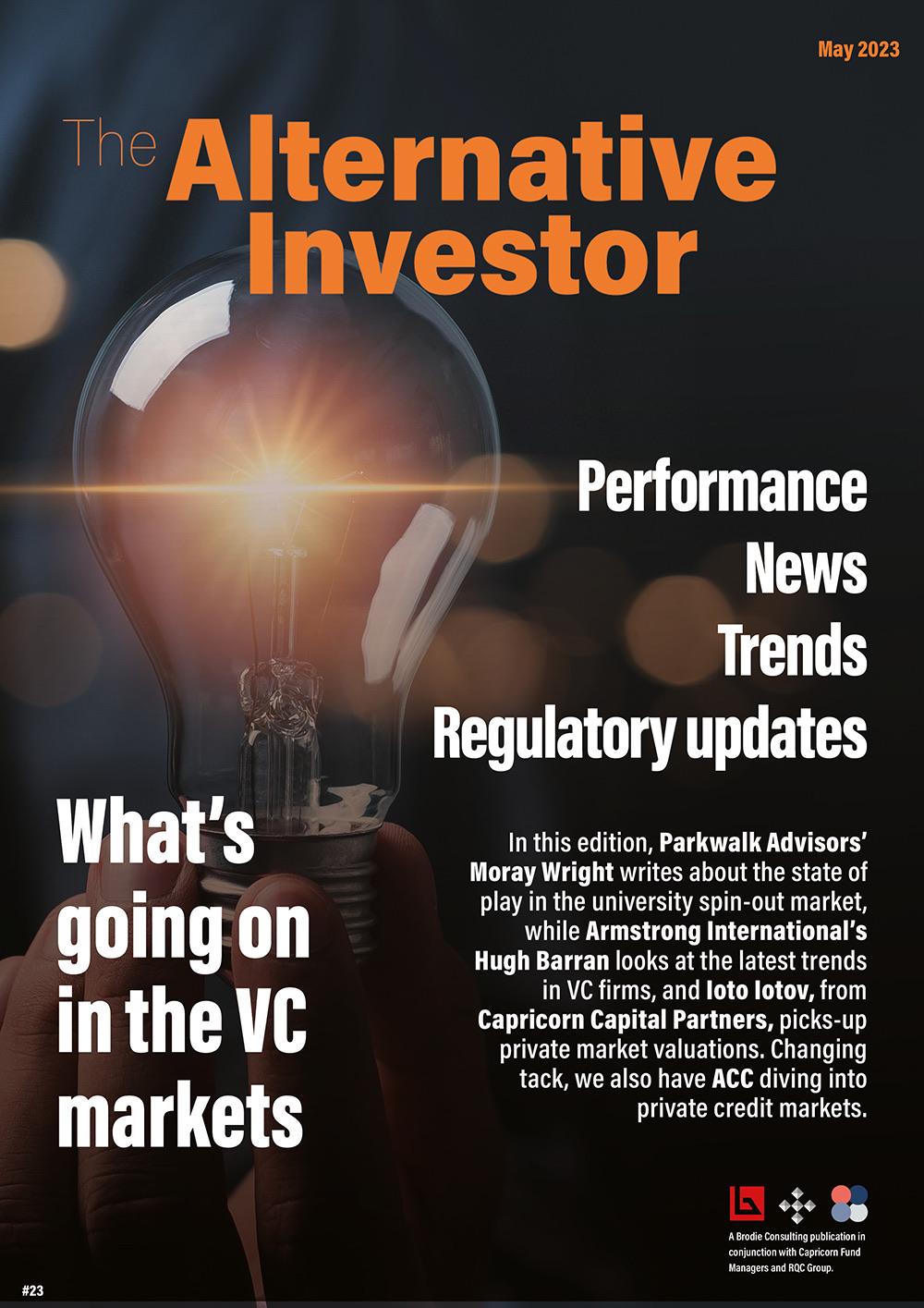
May 2023
May edition, looking back at the news and views from the alternative investor space
Read the issueIn this issue
34 articles: 5 features and columns, 26 news, 3 regulation.
Features and columns · 5
While there were fewer economic surprises in April, investors largely sat on the sidelines, reflected in a muted VIX which by month-end was at a multi-year low. Hedge strategies had a reasonable month, the HFRI Fund Weighted Composite +0.4% and Asset Weighted Composite +0.7%. Macro was the best-performing strategy alongside Fund of Funds. India led the regions at +6.0%.
The UK has no shortage of talented people looking to commercialise their breakthroughs, and its universities produce some of the most cutting-edge ideas. UK spinouts secured £2.5 billion in equity investment in 2021, an almost 70% rise on the previous year and a five-fold increase on 2012. The independent review of university spinouts could not come at a better moment.
This year has been somewhat surprising on the VC hiring front, with many funds still looking to add investors to their team, mostly robust platforms running pre-seed to seed as their primary strategy with a good history of exits. If only 19% of companies get to Series A in Europe, the low probability of success means VCs must continue to invest whatever public markets do.
That private market multiples have come off the highs of 2020-2021 is not news; the why is worth exploring. Four reasons are proposed, with the fifth being higher interest rates. Mood in public markets, the valuation method employed, the emergence of the bottom line over the supremacy of the top line, and a venture market closed back to where it was 18 months ago.
Credit risk is paramount for a sector which typically involves holding investments to maturity, and many of the factors affecting it are more salient than they have been for some time. Inflationary pressures, supply chain disruptions and higher energy costs are putting pressure on the corporate sector, while broader challenges in banking constrain access to credit.
News · 26
The SEC has announced amendments to Form PF, the confidential reporting form for SEC-registered investment advisers to private funds, intended to give the regulator greater visibility and fewer surprises. Hedge funds with more than $1.5 billion in assets must disclose material losses within 72 hours. AIMA warns the change will create considerable compliance uncertainty.
A glimpse at Citco's first quarter report, which looks at the hedge funds it administers, shows that big funds have been outperforming small ones by some margin. Funds with over $3 billion in assets returned a weighted average of 6.4%, compared with 2.7% for funds of between $1 billion and $3 billion, while those with $500 million to $1 billion of assets returned 3.4%.
There may be market uncertainty, but this year has seen the return of the billion-dollar start-ups, with numbers back at pre-pandemic levels, writes Bloomberg. This follows a few underwhelming years and the launch of SurgoCap Partners, which raised $1.8 billion earlier this year. Four further firms are likely to launch, raising $6.5 billion between them.
Those early signs that macro hedge funds were back have yet to be fulfilled. The strategy was up in April but is still down this year, with managers finding themselves on the wrong side of central bank actions and currency flows. eVestment reported net inflows in the first quarter, but Brevan Howard has terminated a $1 billion macro SMA with Commonwealth Asset Management.
Man Group's intelligence arm, the Man Institute, has upgraded its views on credit long/short from neutral to positive and downgraded macro quant from positive to neutral in its Q2 Hedge Fund Strategy Outlook. Continued volatility should suit macro traders but not macro quant. The Institute suggests avoiding directional credit risk and stays negative on distressed for now.
HFR data points to first-quarter inflows going to larger funds. Funds managing more than $5 billion saw net asset inflows of $7.4 billion, firms managing between $1 billion and $5 billion saw $1.3 billion, and around $330 million went to firms with less than $1 billion. Citco-administered funds show a surge of net outflows in March, $4.8 billion for the quarter.
In line with the trend of investors sticking with big brands, Man Group's latest trading update shows continued positive inflows in the first quarter. Assets increased from $143.3 billion to $144.7 billion, with $1.6 billion going to alternative products while long-only saw outflows of $0.5 billion. GLG Continental European Growth was up 8.7% for the quarter.
The first quarter was busy for activist investors, with 409 companies subjected to their demands. The figures come from Insightia data showing you need to go back to 2018 to find a busier year, when 422 companies were in scope. Activists have been mainly focusing on large caps, a figure rising year-on-year, with a concentration on financial services and industrials.
Since launching in 2014, Bluebell Capital Partners has built a reputation for punching above its weight. In the past month the activist, which manages around $300 million, has taken public stances against Glencore and Bayer, calling for Glencore to dump its coal business and concentrate on copper. With Bayer it is looking to break up the business and change the board.
Nathan Anderson's Hindenburg Research has dropped its latest damning research, this time zeroing in on Icahn Enterprises. Hindenburg announced it was shorting the company, which it views as overvalued by as much as 75%, with inflated valuations for less liquid assets and performance losses yet to be reported. The share price dropped by as much as 36% in two days.
Further evidence that big funds continue to attract assets comes from Clayton Dubilier & Rice, the latest brand to raise over $20 billion for a flagship fund. Fund XII has set a hard cap of $23 billion, a record for CD&R and a third bigger than Fund XI. It will invest in upper mid-market and value-orientated buyouts across North America and Western Europe.
TPG Tech Adjacencies II has successfully raised $3.4 billion to invest in tech companies across all stages of growth through a mix of structured and opportunistic minority investments. This fund is TPG's second tech venture and is above the $2.5 billion that was the initial target.
Alternative firms have been upping their stakes in German software company Software AG. This followed news that Silver Lake has the backing to buy the firm, with its latest bid at €32. Elliott has been building its position given the likelihood of further offers, and Bain Capital has offered €36 per share through its portfolio company Rocket Software. Silver Lake is in pole position.
ConnectWise is up for sale again, valuing the IT firm between $6 billion and $8 billion. Somewhat surprisingly Bain Capital, seen as a front-runner early on, is now out, having low-balled its first offer. Other unnamed large firms are said to be through to the next round. Thoma Bravo acquired the Florida-based firm in 2019 and today has six of the eight board members.
KKR has taken a 29% stake in communications firm FGS Global. The move values the London and New York business, a subsidiary of WPP, at $1.4 billion. As part of the transaction Golden Gate Capital, a shareholder since 2016, has exited. WPP remains the majority shareholder.
News that Subway was on the market for more than $10 billion broke earlier this year. The most recent suitor for the 37,000 outlets across 100 countries is a potential club deal that includes Advent International, Bain Capital and TPG. With the leveraged deal market subdued, Subway's banker JPMorgan has pulled together a $5 billion finance package to encourage the sale.
According to Preqin data, the first quarter saw private equity raise $147.7 billion, with 168 new vehicles. This is not too far off last year's $150.1 billion for the same period, although it remains some way off the 2021 figure of $189 billion, raised by 399 firms. North America accounted for 71% of this figure and 112 vehicles.
While the numbers are relatively small, it is interesting to see Warburg Pincus take a 23.3% stake in China's Zhou Asset Management. With many firms pulling back from their China expansion, not all asset managers have given up on the country's $2 trillion funds market. Pincus already has a 29% stake in Hwabao WP Fund Management, acquired in 2017.
A recent development in the secondaries market is the possible acquisition of one of the largest portfolios in this space. This is part of healthcare provider Kaiser Permanente's pension plan, which according to reports is offloading around $5 billion in private fund positions. Buyers include Ardian, Blackstone and Apollo Global Management.
On the subject of secondaries, according to Preqin the secondaries private equity market is expected to strengthen this year. This is the result of public and private valuations becoming more closely aligned. It also comes as the first quarter saw 11 secondaries funds close, raising $32.5 billion, which is more than the whole of the previous year.
Blackstone's strong first-quarter results revealed almost $200 billion of dry powder, a fifth of its assets and an industry record, with around $85 billion destined for private equity and the remainder for credit and insurance. AUM rose to $991.3 billion, up 8% year-on-year, after $40.4 billion of inflows during the quarter, the biggest driver being real estate at $17 billion.
Carlyle Group has been given a tough ride by multiple parties over the past year. The latest is The Guardian, which accuses the firm of being particularly dirty, reporting that between 2011 and 2021, 90% of the estimated 91 energy companies Carlyle backed were fossil fuel options. Carlyle disputes the findings, responding that its renewables investments are outpacing fossil fuels.
Blackstone has announced the final close of Blackstone Real Estate Partners X with $30.4 billion of total capital commitments. This is the largest real estate fund ever raised and is 50% bigger than the previous $20.5 billion Fund IX in 2019. It comes at a time when its real estate business has been under pressure, having gated the $70 billion BREIT last year.
With private equity exits proving more problematic in this environment, EQT is looking at the various other options available to them. These words came from CEO Christian Sinding, who spoke about this on the firm's first-quarter earnings call, saying that partial sales and continuation vehicles were being considered.
The first quarter was particularly quiet for venture capital funds. There were only 144 VC funds closed in the quarter, compared against the five-year average of 460. This comes from Preqin data that reports total VC fundraising for the quarter at $27.5 billion, slightly up on the previous quarter, but down 67% from the first quarter of 2022.
Hong Kong based VC firm CMCC Global has launched a $100 million Asian-focused blockchain fund. This will invest in blockchain and cryptocurrency infrastructure, fintech and consumer, and claims to be one of the first in Asia. Backing CMCC are the crypto twins, Cameron and Tyler Winklevoss.
Regulation · 3
On 5 April the FCA published its Business Plan 2023/2024, setting out how it will deliver the second year of its 2022-25 Strategy. There are no surprises and the content builds on pre-existing themes. The FCA acknowledges uncertainties in the geopolitical and economic climate, and believes the new Consumer Duty, in force on 31 July, will be key to protecting customers.
The FCA's Chief Data, Information and Intelligence Officer delivered a speech at the Innovate Finance Global Summit on innovation, AI and the future of financial regulation. It followed the Department for Science, Innovation and Technology White Paper on a pro-innovation approach to AI regulation. A new Digital Sandbox combines synthetic data and a test environment.
The SEC charged New Jersey based investment adviser Chatham Asset Management and its founder with improper trading of fixed income securities. Together they agreed to pay over $19.3 million in combined disgorgement, prejudgment interest and civil penalties. From 2016 through 2018 one Chatham-advised client sold illiquid bonds while another client bought the same bonds.
Receive The Alternative Investor each month, with news and features from across private capital.
Subscribe