April 2023
April edition, looking back at the news and views from the alternative investor space
Read the issueIn this issue
29 articles: 4 features and columns, 21 news, 4 regulation.
Features and columns · 4
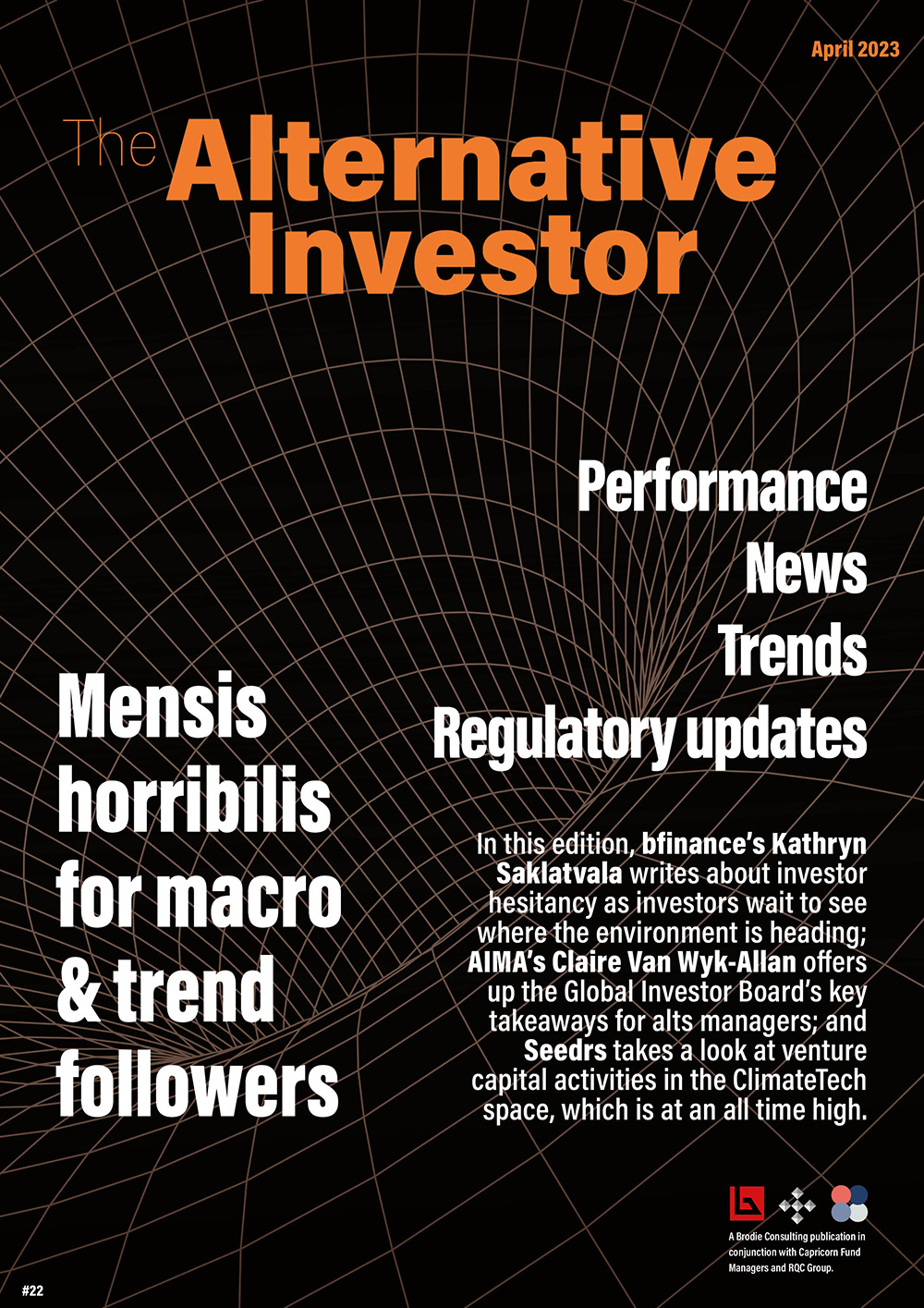
March was a difficult month for hedge funds, with a broad range of returns across strategies as the bear market took hold and buyers quickly became sellers. Macro managers had a torrid month, the HFRI Macro (Total) Index falling -3.2%, with Trend Following -4.6%. Equities were very different, the HFRI Equity Hedge (Total) Index up +0.9%. Event Driven fell -1.7%.
The past year has seen a notable slowdown in the volume of manager search activity conducted by institutional investors such as pension funds, insurers, foundations and university endowments. A turbulent macroeconomic environment has placed many investors in wait and see mode, with new mandates across all asset classes down more than 10% in 2022 versus 2021.
AIMA's Global Investor Board, launched in December 2021 and now nearly 20 senior leaders at institutional investors from across the world, provides insights on trends impacting alternative asset allocation. Eight takeaways for managers cover partnering with investors, sharing the expense, a new equilibrium on fees and terms, ESG, the denominator effect and valuation.
2022 was a year of transition and consolidation for ESG investing. Regulatory changes and global economic headwinds saw European equity ESG funds underperform their benchmarks by 5%, worse than the 4.6% recorded by traditional rivals. Yet while global investment activity sunk by 57% in 2022, ClimateTech funding achieved an all time high, taking 25% of venture funding.
News · 21
Having seen US regional banks topple over the past month, regulators and analysts are taking a closer look at the liquidity and makeup of private equity-backed insurers' books. The concern is the size and complexity of their corporate loans, which is beyond the risk tolerance of most traditional insurers. Apollo, Blackstone and KKR are among the big players in this space.
Indicative of these times is the rise of portfolio bankruptcies in the private equity space. According to S&P Global Market Intelligence data, of the 143 US companies to file for bankruptcy in the first 75 days of this year, 16 were private equity or VC-backed. If the trend continues, the total by year-end will be double that of 2021 and 2022.
In a tricky fundraising environment, particularly in the tech space, US private equity firm Accel-KKR has announced that it has successfully raised $5.3 billion for a pair of funds. This is for Accel-KKR Capital Partners VII LP and Accel-KKR Emerging Buyout Partners II LP, which will invest in software and tech-enabled service companies.
McKinsey's report into private capital describes 2022 as a year of two halves, a buoyant first half followed by plummeting deal volumes, declining performance and falling valuations. The momentum of 2021 continued into the start of the year, which meant 2022 turned out to be the second most active on record, masking an increasingly difficult environment.
Bain has released its latest Asia Pacific Private Equity Report, showing a similarly depressed picture to McKinsey. The total number of deals in the region fell by 44% to $198 billion, and exit values dropped by 33% to $132 billion, following a record 2021. China's covid lock-downs, slowing growth and US tensions contributed to a 53% fall in Greater China deal flow.
Given the activist and private equity interest, the goings-on at Toshiba have been closely followed for a few years. Last month we wrote about the preferred bidder, JIP Group, submitting its bid, which has since been agreed. As a domestic deal, the consortium placates the government's concerns about Japanese technology falling into foreign hands.
In what has already been a particularly barren year for M&A, Silver Lake and Canada Pension Plan have announced the acquisition of Qualtrics for $12.5 billion. This is the biggest buyout of the year and the second time the specialist software firm has been bought in recent years, having been acquired by SAP for $8 billion in 2018 and listed in 2021.
There are signs that NFL franchises may soon open the door to private equity money as owners push for looser restrictions on ownership. Such a move would allow owners to get higher prices and dilute their stakes, following the NBA, which today has various private equity-owned teams such as the Phoenix Suns. Current rules require a 30% stake from the principal investor.
With investors focusing on the biggest brands during tough times, it is interesting to see Blackstone launch a branding push as it looks to grow its non-institutional investor base. Build with Blackstone is the tagline and campaign. It ties in with a Bain & Co survey of 418 high net-worth individuals that found surprisingly low levels of brand awareness of alternative firms.
In line with the depressed environment, this year's IPOs are back to 2019 levels. According to Dealogic data, global IPOs have raised a paltry $26 billion in the first quarter. Various businesses have delayed or called off floats, with the SVB debacle causing the latest jitters. JPMorgan's head of ECM Americas believes the market will not reopen until the second half.
Crispin Odey has a habit of pouncing when the rest of the world runs for the hills. With UBS shares bottoming, he invested 2% of Odey Asset Management's funds in the Swiss bank, telling Bloomberg it should have been 5%, believing the sector and the shares to have sold off too aggressively. Odey had a stellar 2022, with the European Inc. fund up 152%.
After his stunning performance over the past few years, Pierre Andurand has found himself on the wrong side of recent commodity moves. According to Bloomberg his fund was up 154% in 2020, 87% in 2021 and 59% in 2022. The negative trend has continued into 2023, with the fund down 19% in only the first few weeks of the year, and by mid-March down 40%.
Macro and CTA managers had a torrid March as bond markets reversed. The catalyst was the collapse of SVB, described by the Bank of England as the fastest failure since Barings, followed by the sale of Credit Suisse to UBS. Monday 13 March will be remembered as Black Monday in the macro world. Societe Generale's CTA index was down around 6% for the month.
Chris Rokos has derisked his portfolio after recent losses. The news comes from an investor letter that Bloomberg got hold of, which in turn was in response to a Financial Times article about SEC concerns over his bond positioning. Rokos says that cash remains at healthy levels, and there have been no requests for additional margin.
Shortly after taking a shot at Airbus' Atos deal, Chris Hohn has turned his attention from France to Spain and is zeroing in on Cellnex. TCI has a 3.1% stake in the Spanish telecoms infrastructure and services business and 5.9% in derivatives. In his letter to the board, Hohn questioned the selection process for the new CEO, which he believes was mishandled.
Hindenburg Research's latest victim is Block, the NYSE-listed firm run by Jack Dorsey. Hindenburg has conducted two years of research into the $30 billion firm, previously called Square Inc., which it accuses of inflating user metrics and frictionless fraud to allow insiders to take out more than $1 billion. The stock tumbled as much as 22% before closing down 15%.
Against the long-term trend, February saw a large chunk of assets leave the hedge fund industry, according to eVestment data. Since 2009 February has been seeing the largest average inflows to funds; this year $4.8 billion has gone out of the door, taking year-to-date outflows to $5 billion. eVestment puts this down to a pause in new allocations rather than mass exits.
For a sector that was once media shy, plenty of managers are now opining about the state of markets and central bank action. In the wake of SVB and Credit Suisse, pessimism is running rife. Doom-mongers include Ken Griffin, who believes US capitalism is breaking down before our eyes, and Bill Ackman, who said he was extremely concerned about contagion from bank failures.
Having already seen a peak to trough fall of over 50%, funds have been reining in their bets against Scottish Mortgage Investment Trust. These include James Hanbury's Brooks Absolute and Developed Market funds, writes the Financial Times. The Trust has had a difficult time of late, with the share price halving and questions from a non-exec director over governance.
Blackstone has offered £700 million, or a 42% premium, to buy British commercial property company Industrial Reits. The move, which has the backing of the board, comes as the property market comes under increased pressure from rising rates and uncertain markets but, at the same time, offers cheaper deals. Blackstone's own property funds have faced heavy redemption requests.
Always an interesting read on the state of the crypto market is Coinshares' Digital Asset Fund Flows report, with the latest showing investors are once more back in the digital game. The 27 March edition reveals $160 million of inflows to exchange-traded products, the largest number since July 2022 and following six weeks of outflows totalling $408 million.
Regulation · 4
On 30 March 2023 the Bank of England and HM Treasury published separate call for evidence documents on the Senior Managers and Certification Regime. The review, conducted by the FCA and the PRA, looks at the effectiveness, scope and proportionality of the regime, and forms the basis of the Bank of England's Discussion Paper DP1/23. Responses are requested by 1 June 2023.
The FCA has published its latest operating service metrics for authorisations timelines, covering approved persons applications, appointed representative notifications, new firm authorisations, variations of permission and change in control. The FCA recognises there is room for improvement and is recruiting additional staff and enhancing the triage process.
On 9 March 2023 HM Treasury announced the appointment of a new chair to lead the Investment Research Review, formally launched on 13 March. Rachel Kent, a senior partner at Hogan Lovells, will lead the review, with an initial report expected by mid-June 2023. It will consider the provision of investment research in the UK and London's attractiveness as a place to list.
On 27 March 2023 the SEC's Division of Examinations published a Risk Alert setting out the typical focus areas for examinations of newly-registered investment advisers. It also shares the Division's observations regarding compliance policies and procedures, disclosures, and marketing practices. Examinations typically involve document requests and interviews with personnel.
Receive The Alternative Investor each month, with news and features from across private capital.
Subscribe