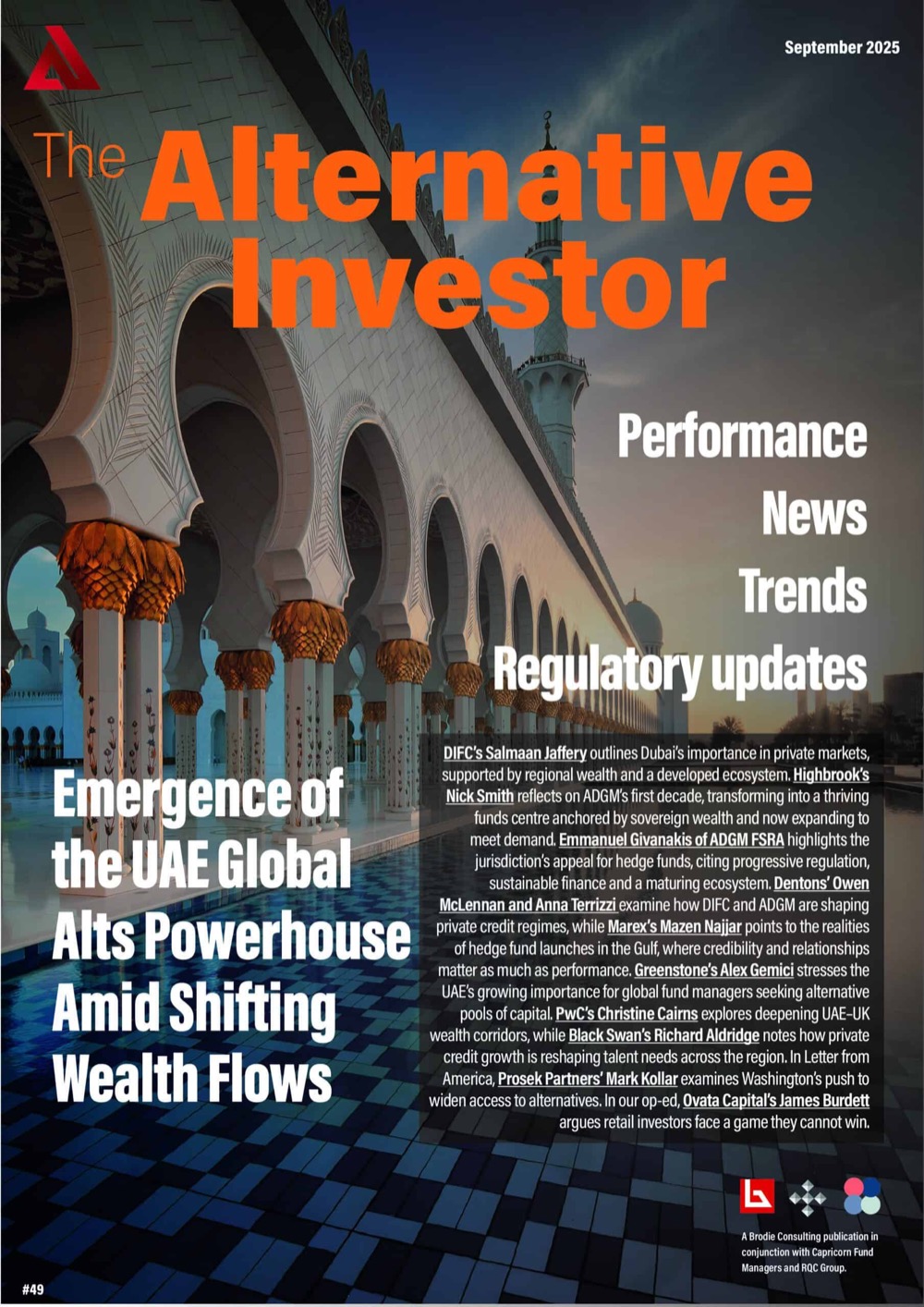
September 2025
The UAE’s role in the growth of private capital
Read the issueIn this issue
34 articles: 11 features and columns, 15 news, 8 regulation.
Features and columns · 11
August markets were finely poised, surging to record highs only to retreat just as quickly, as investors weighed the looming prospect of rate cuts, renewed trade tensions and increasingly complex political risks. Despite the volatility, both the S&P 500 and Nasdaq hit fresh all-time highs mid-month, with the HFRI Fund Weighted Composite Index advancing 2.3%.
The rise of the retail investor has been hailed as a triumph of financial democracy. No longer are Wall Street elites the only ones with access to markets: anyone with a smartphone can trade at the tap of a screen. Indeed, retail now accounts for around 20% of US equity flow, and apps like Robinhood, FUTU and eToro promise to level the playing field.
Back to it after an August that was anything but a lazy slumber at the end of summer, thanks in part to new developments and ongoing debates around private markets and US retirement funds. Until recently, only certain target-date or asset-allocation funds could incorporate alternatives as an investment option if they met certain ERISA fiduciary standards.
The global financial landscape is entering a new era, one which demands a rethinking of traditional approaches to capital formation and investment. Private markets are redefining the rules of global investing and emerging as the new frontier for capital allocation. Global private wealth, now exceeding USD 470trn, is increasingly mobile.
A century ago, Al Maryah Island, named after the Arabian deer that once inhabited the region, was home to pearl-diving and fishing. By 2007, when I first came to the UAE as an Allen & Overy investment funds partner, it had become a modest hub for the local oil and gas industry. All was to change.
ADGM has rapidly emerged as a leading international financial centre, attracting a growing number of renowned global fund managers. This growth is driven by ADGM's comprehensive, robust and progressive regulatory framework, including fund management and fund structures, which is aligned with international regulatory standards.
In essence, private credit represents the expanding of credit beyond traditional banking systems through providing an avenue for entities to access capital with unique credit structures that banks cannot offer. It is, therefore, unsurprising that the global private credit market has developed in the last decade to almost US$900 billion.
The UAE is quickly emerging as a rising hub for hedge fund managers looking to establish a presence in the Middle East. Over the past 18 months, there has been growing interest from funds in the $10 million to $300 million AUM range seeking to set up and scale in the region.
The UAE has rapidly emerged as a crucial hub for global fund managers seeking to access new pools of capital. As the Middle East grows in both size and influence, the UAE's strategic position in the global economy, combined with a flourishing private wealth sector, has made it an increasingly attractive market for investors to allocate capital.
The United Arab Emirates has rapidly established itself as a premier destination for family offices, ultra-high-net-worth individuals, and global investment professionals. This transformation is not only reshaping the regional wealth management landscape but is also having a profound impact on the flow of talent and capital between the UAE and the UK.
From a recruitment perspective, it is the Private Credit market that continues to gain significant traction across the GCC region, with DIFC and ADGM proving the local hot spots. A combination of investor appetite, economic diversification and a maturing regulatory framework have all fuelled this regional growth.
News · 15
Stone Point Capital closed its tenth flagship fund, Trident X, with total commitments of $11.5 billion, surpassing the original $9 billion target. The Greenwich-based private-equity firm invested approximately $750 million of its own capital, while existing investors reinvested at an impressive 88% rate, with new global investors contributing around $3 billion.
Neuberger Berman closed NB Strategic Co-Investment Partners V, securing approximately $2.8 billion in commitments, well above its $2.25 billion target. The close bolsters the company's co-investment platform to over $40 billion in dedicated capital. The fund is designed to participate alongside leading private equity sponsors in direct equity deals globally.
Coller Capital closed Coller Credit Opportunities II, a private credit secondaries fund at $6.8 billion, surpassing its predecessor's $1.4 billion close in 2022. The London-based firm plans to deploy approximately $5.8 billion toward acquiring senior, performing loans from both GP-led and LP-led vehicles.
Haveli Investments announced the final close of its debut fund, Haveli Software Fund I, at $4.5 billion, exceeding its $4.25 billion target. The Austin-based firm, founded by former Silver Lake executive Brian Sheth, is targeting enterprise software businesses and growth-stage opportunities, aiming to combine operational support with long-term capital.
BlueFive Capital has raised $2bn for its debut growth equity fund, targeting mid-stage technology and consumer companies. Founded by former executives from Insight Partners and TPG Growth, the firm aims to bridge the gap between venture and buyout capital, offering flexible deal structures and minority stakes.
New Mountain Capital raised $3bn in a continuation fund to extend its ownership of Real Chemistry, a healthcare communications platform. The deal gives existing LPs the option to cash out or roll over, underscoring yet another use of GP-led secondaries as a liquidity tool.
In a sign of sport's growing appeal as an asset class, Apollo Global Management is launching a $5 billion fund to channel capital into teams, leagues and clubs. The initiative, first reported by the Financial Times, will combine credit provision to leagues and teams with equity investments in clubs.
Carlyle is starting to see good progress, with stronger quarterly fee income and assets under management rising to $465 billion, reflecting the leadership of Harvey Schwartz. The FT notes that half of the analysts covering Carlyle now rate the stock a buy, citing rising investor confidence.
We have been tracking Apollo AUM growth over the past few years as it chases down Blackstone. Second-quarter earnings for the period ended June 30 2025 delivered a strong performance: AUM surged to $840 billion, up 21% year-on-year, driven by $61 billion in net inflows. Fee-related earnings hit a record $627 million, rising 22%.
Having raised a record $20 billion for AlpInvest Secondaries Program VIII, Carlyle Group has nearly doubled the size of its predecessor and cemented secondaries as its fastest-growing business line. The package includes $15 billion for the flagship fund, $3.2 billion of co-investment commitments, and $2 billion from private wealth vehicles.
Abu Dhabi's Lunate is set to take a minority stake in Brevan Howard while committing $2 billion to a new investment platform, underscoring the emirate's rising firepower in global alternatives. For Brevan, the tie-up brings both fresh capital and closer alignment with one of the Middle East's most ambitious investment groups.
There is no let-up in multi-manager hedge funds allocating large sums to external launches, reinforcing their strategy of tapping specialist talent. Bloomberg reported that Millennium Management has committed $1 billion to Qin Xiao's new Singapore-based Nexus Commodities Capital Management.
Former Viking Global CIO Ning Jin is set to launch Avantyr Capital, a long-short equity fund targeting an initial $1 billion in assets. According to recent regulatory filings, the firm has a 19-person team including 10 investment professionals, based in Manhattan. Avantyr will focus on the technology, media, telecoms, consumer, financials, and industrials sectors.
Scale-driven consolidation is increasingly defining the hedge fund landscape, with Qube Research & Technologies planning to merge its Torus and Prism funds into a single $20 billion pool by December 2025, writes Bloomberg. The London-based quant firm managed approximately $28 billion as of March 2025.
Tougher non-compete clauses are becoming a feature of the private capital industry, with investment staff at major firms facing longer restrictions before they can join rivals. In February 2025, Man Group extended its non-compete periods, a move that has proved deeply unpopular internally, with some employees already exploring opportunities elsewhere.
Regulation · 8
The Financial Conduct Authority is sharpening its focus on workplace culture with new rules that bring serious non-financial misconduct, such as bullying, harassment, and violence, within the scope of regulatory oversight for all solo-regulated firms, including hedge funds. The rules take effect from 1 September 2026.
In July 2025, the FCA, Prudential Regulation Authority and HM Treasury released consultation papers proposing updates to the Senior Managers and Certification Regime, a framework central to individual accountability in UK financial services. The FCA is seeking feedback by 7 October 2025, with final rules expected mid-2026.
On 23 July 2025, the FCA published Market Watch 82, the latest in its series on market conduct and transaction reporting issues. Incorporating the regulator's recent findings from supervising the UK MiFID transaction reporting regime, this newsletter recommends their integration into firms existing transaction reporting processes.
On 29 July 2025, the FCA fined Sigma Broking Limited £1,087,300 for failing to submit complete and accurate transaction reports over a five year period. In agreeing to resolve the case at an early stage, Sigma qualified for a 30% discount, without which the penalty would have been £1,553,300.
In August 2024, the FCA reported an enforcement and public redress exercise against asset manager H2O AM LLP. The following year, on 25 July 2025, the FCA announced it had fined the company's deputy CEO, Jean-Noel Alba, £1,049,500 and banned him from financial services for lack of integrity.
The US Department of the Treasury's Financial Crimes Enforcement Network on July 21, 2025 announced its intent to delay the effective date of the Anti-Money Laundering and Countering the Financing of Terrorism rule for Registered Investment Advisers and Exempt Reporting Advisers from January 1, 2026, to January 1, 2028.
On August 15, 2025, the Securities and Exchange Commission announced charges against a New York-based registered investment adviser for breaches of fiduciary duty regarding management fee calculation practices for its private fund clients related to compensation it received from portfolio companies.
The Securities and Exchange Commission on August 14, 2025 charged an Indiana-based portfolio manager for violating his fiduciary duty by investing his private fund client in a fraudulent scheme. Separately, the SEC has also charged the operators of the fraudulent scheme. More than $165 million was raised, primarily from retail investors.
Receive The Alternative Investor each month, with news and features from across private capital.
Subscribe