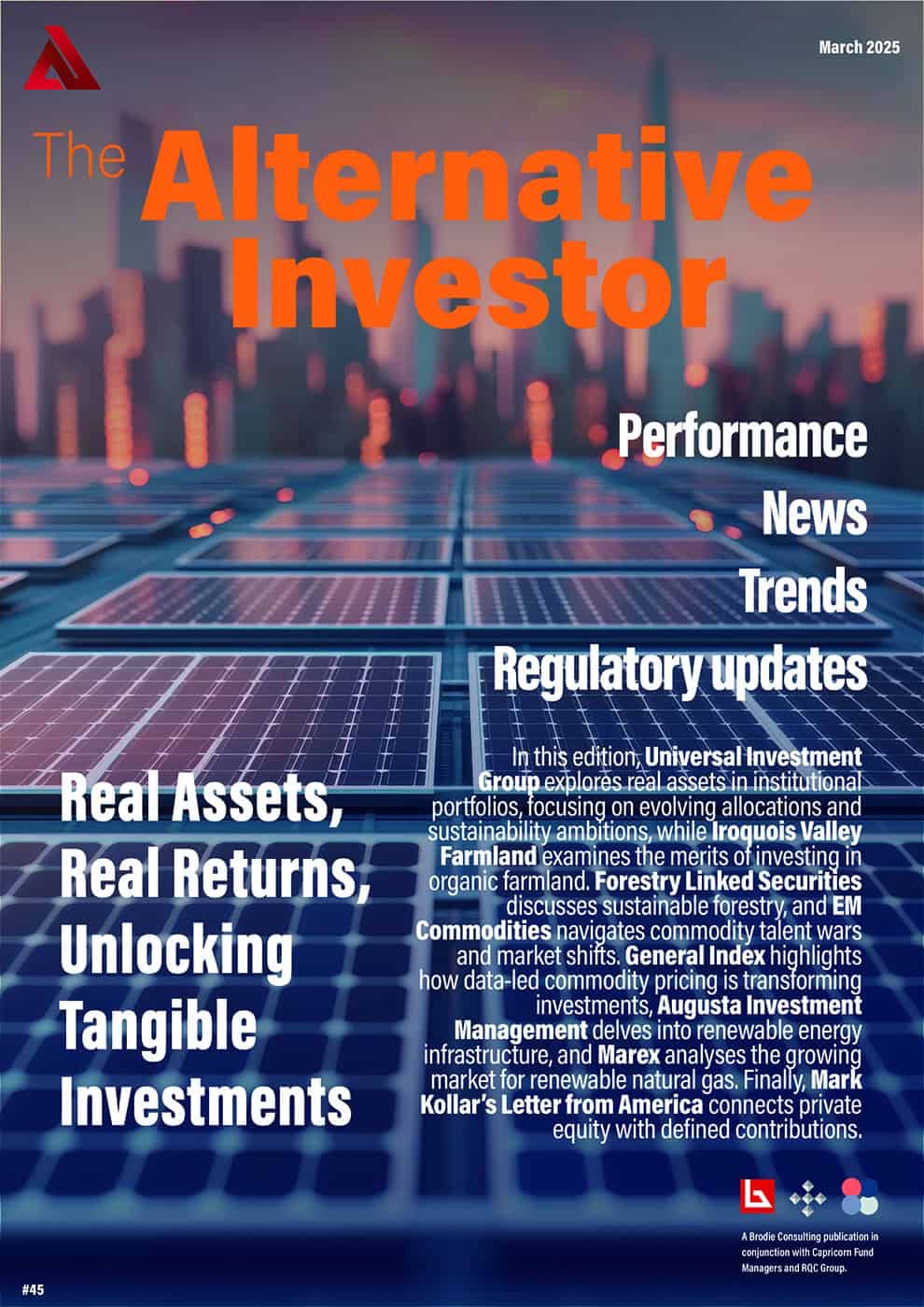
March 2025
Real Assets, Real Returns: Unlocking the Power of Tangible Investments
Read the issueIn this issue
29 articles: 9 features and columns, 18 news, 2 regulation.
Features and columns · 9
After a strong start to the year, February was more difficult for hedge funds as heightened tensions, policy shifts and economic uncertainty shaped global geopolitics and financial markets. By close of month, the HFRI Fund Weighted Composite was down 0.5%. Technology was the worst performer, down 3.9%, as AI competition, tariff uncertainties and inflationary pressures took a toll.
At a time in the US when the White House is changing some of the rules of the game on Wall Street and suggesting new schemes on tax rates, it is probably worthwhile to take a look at the swirl around American tax-deferred defined contributions plans such as 401(k)s and the push from private-equity firms to grab a piece of a highly valuable prize.
In 2025, real estate transaction activity is expected to gradually recover, driven by improved interest rate clarity and more realistic pricing expectations. Against this backdrop, German institutional investors are evolving their real estate strategies for a more global, diversified and sustainability-conscious future.
Today, farmland as an asset class is valued at $3.2 trillion, and as reported by American Farmland Trust, 40% of that land is expected to change hands within the next 15 years. Yet farmland remains underrepresented in institutional investment portfolios, with less than 5% currently allocated to this asset class and a mere 2% of farmland certified as organic.
The 2004 Who Cares Wins report of the UN is widely credited with bringing ESG into the mainstream, spreading the gospel that investors could make money while saving the planet. But as sustainable investing turns 21, that narrative is evolving. Every investment involves trade-offs, with forestry no exception.
The Renewable Natural Gas market has long been seen as a niche segment of the clean energy transition. However, it is gearing to become the next significant investment opportunity within environmental markets as it captures the attention of investors seeking exposure to sustainable real assets. In the United States alone, 500 facilities are likely to be operational by the end of 2025.
Renewable energy infrastructure is an attractive long-term investment proposition for allocators globally, perhaps even more so in this drill baby drill environment. Recent upheavals in the European energy landscape have meant that the argument on renewables has moved on from CO2 reduction to energy security.
Commodities as an asset class have caught the headlines in many ways over the last four years with huge price swings across the board, driven by a collision of competing and often disruptive influences: post covid recovery, energy transition, the Russia and Ukraine war, deglobalisation and the rise of power politics.
In the evolving world of commodities, data has become a critical driver of investment strategies. As markets grow more interconnected and volatile, alternative investors are increasingly relying on real-time, transparent and data-driven pricing to make informed decisions. The shift from traditional price-setting mechanisms is reshaping how capital flows into commodities.
News · 18
Credit specialist Oaktree Capital Management closed its largest distressed debt fund, Oaktree Opportunities Fund XII, with around $16 billion in commitments including co-investment and affiliated vehicles. Over $7 billion has already been deployed, with early investments focused on rescue financing and opportunistic capital solutions.
PSG raised $8 billion across two new funds. The flagship fund, PSG VI, closed with $6 billion, exceeding the $4.7 billion raised by its previous fund, and the firm launched a $2 billion continuation fund, PSG Sequel, with backing from Canada Pension Plan Investment Board and GIC. The firm plans to use its AI-driven sourcing technology to identify software companies.
While investor interest in energy transition has been a tough sell recently, Blackstone has successfully closed its latest energy-transition-focused private equity fund, Blackstone Energy Transition Partners IV, at its hard cap of $5.6 billion, 33% larger than its predecessor. The fund is investing in grid modernisation, electrification and energy efficiency.
Tech specialist Thoma Bravo closed its first European-focused fund, raising approximately EUR 1.8 billion. This surpasses the initial target of EUR 1.5 billion and follows the establishment of the London office of the firm in 2023, marking its first expansion outside the US. In 14 years Thoma Bravo has invested over EUR 14 billion in European deals.
Balyasny Asset Management is fundraising for its first venture capital fund, targeting $350 million. The move, initially reported by PitchBook, reflects a broader trend among hedge funds to expand into private equity and venture capital as they seek greater diversification. The new fund will focus on growth-stage enterprise investments.
Invesco Private Credit closed its flagship Invesco Direct Lending Fund II with $1.4 billion in the fund and related vehicles. This is part of the $48 billion direct lending strategy of the firm, targeting senior secured loans for sponsor-backed middle-market companies in North America with EBITDA between $20 million and $75 million.
Blackstone is working on its fifth Tactical Opportunities fund, following the success of the 2023 Fund IV which closed at $5.2 billion, surpassing its $4.5 billion target. The Tac Opps platform, a $37 billion investment strategy, provides flexible capital across asset classes, industries and geographies. Fund V will be launched alongside the latest GP stakes fund and a tenth secondaries fund.
According to reports, the latest North America buyout fundraise of KKR is progressing well as it closes on its targeted $20 billion. As of February 2025 the firm had secured nearly $14 billion, with significant contributions from Washington State Investment Board and Cathay Life Insurance. KKR plans to deploy the capital over six years.
Hamilton Lane closed its inaugural Venture Access Fund, raising $615.3 million against a $500 million target, blending primary and secondary transactions. It also launched the Hamilton Lane Private Secondary Fund, an evergreen vehicle providing US accredited investors access to its secondary platform with quarterly liquidity and minimums from $25,000.
The rise of continuation funds is an accelerating trend in private equity as firms look to hold onto high-potential assets while navigating valuation pressures and market uncertainties. In line with this trend, JLL Partners has launched a $1.1 billion continuation fund for Solvias, a Swiss pharmaceutical research and manufacturing company, backed by TPG and Pantheon.
Apollo announced the acquisition of Bridge Investment Group in an all-stock transaction valued at approximately $1.5 billion. The move adds $50 billion of Bridge assets to the Apollo portfolio, increasing its real estate funds to over $110 billion. Bridge will continue to operate as a standalone platform, retaining the existing brand and leadership team.
There is little sign of any slowdown in private credit as US banks double down on commitments. JPMorgan Chase is the latest, announcing a $50 billion expansion of its direct lending initiatives to finance private equity-backed companies. This takes the total allocation of the bank to over $60 billion since 2021, with more than $10 billion deployed across 100 transactions.
Active ETFs have rapidly gained traction in the US investment market, with Goldman Sachs Asset Management now looking to expand its active business into Europe, tapping into demand from wealth managers and private banks. The European active ETF market is still relatively small, with approximately $50 billion in assets, but forecasts suggest it could grow to over $1 trillion by 2030.
Analysis by Reuters of SEC Q4 2024 filings reveals a big increase in cryptocurrency holdings among major hedge funds and institutional investors. Millennium Capital Management emerged as a leading player, reporting $2.6 billion in Bitcoin ETF holdings and $182.1 million in Ethereum ETFs. Tudor Investments and Abu Dhabi sovereign wealth fund Mubadala also built stakes.
With financial service tie-ups increasingly common, State Street Global Advisors and Apollo Global Management are the latest to co-launch a vehicle, with the SPDR SSGA Apollo IG Public and Private Credit ETF providing retail investors access to investment-grade private credit exposure. The actively managed fund can allocate up to 35% to private credit.
Blackstone reported a strong set of numbers for 2024, with distributable earnings rising 18% to $6 billion and fee-related performance revenues up 149% year-on-year. Assets grew to a record $1.1 trillion, fuelled by $171 billion in inflows. Its credit arm became the largest unit of the firm, with AUM climbing 20% to $375 billion.
Similar to Blackstone, Apollo Global Management reported impressive financial results, with a 14% increase in adjusted net income for the year totalling $4.5 billion and earnings per share surpassing analyst expectations. Apollo AUM grew by 15% to $751 billion, driven by $152 billion in inflows, primarily from credit-focused strategies and wealth products.
Man Group reported a strong set of financial results for 2024, with core net management fee revenue up 14% to $1.1 billion and core profit before tax rising 39% to $473 million. AUM grew to $169 billion after a single client redeemed $7.0 billion in Q3. Fund performance was mixed, with the flagship 1783 multi-strategy fund gaining 14.5% while the systematic AHL Evolution fund fell 6.1%.
Regulation · 2
The Asset Management and Alternatives Supervisory Strategy letter of the FCA, published on 26 February 2025, sets out the supervisory focus and targeted work of the regulator for 2025. The UK is the largest centre for private markets in Europe, and the FCA has identified three risk areas: asset valuation, conflicts of interest and retail engagement.
In the latest episodes of the continuing courtroom saga, on 18 February the US District Court for the Eastern District of Texas lifted a previous injunction that had blocked enforcement of the Corporate Transparency Act, reinstating the requirement for companies to disclose their beneficial owners to FinCEN.
Receive The Alternative Investor each month, with news and features from across private capital.
Subscribe