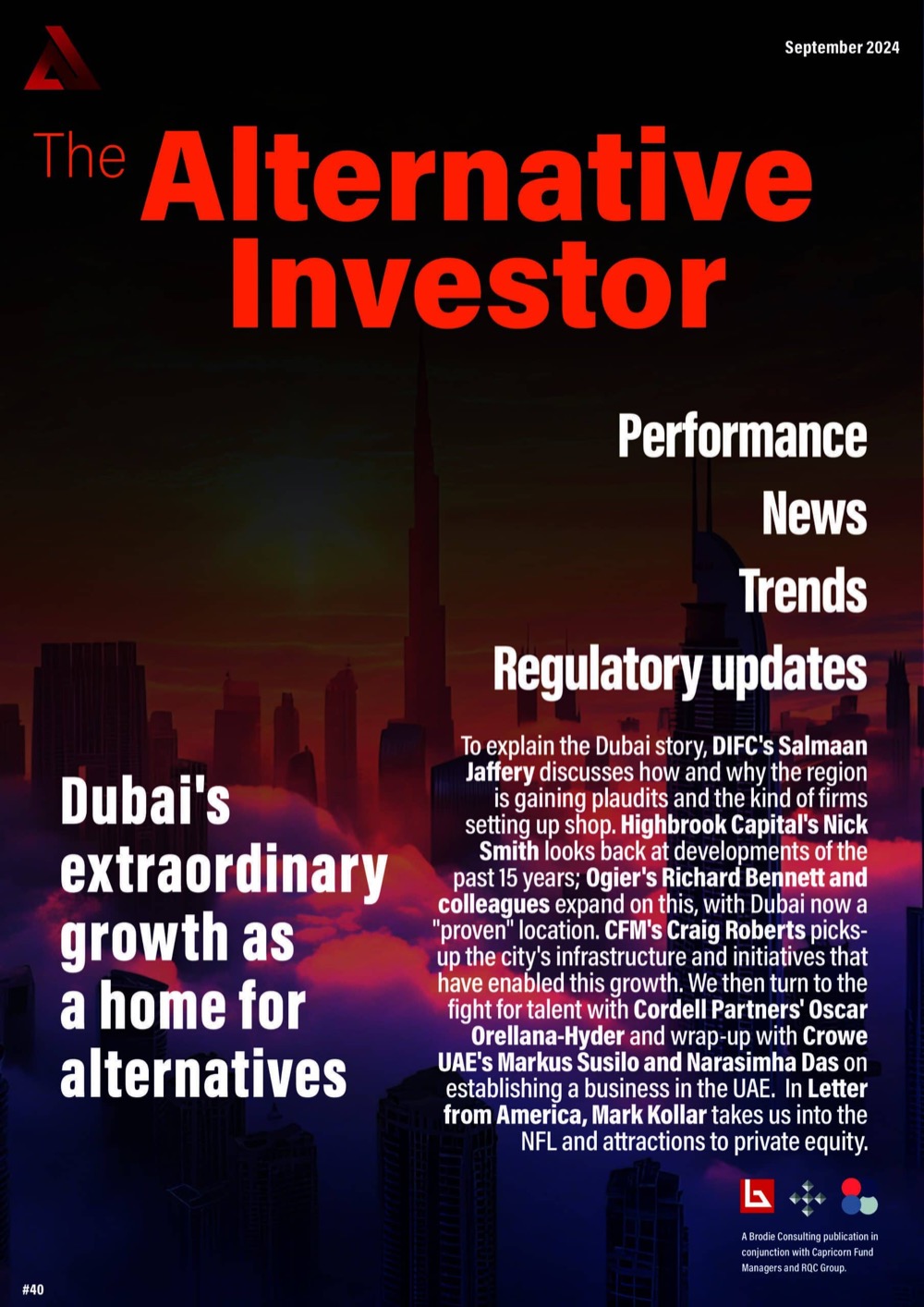
September 2024
The unstoppable rise of Dubai as a hub for alternative funds
Read the issueIn this issue
31 articles: 8 features and columns, 17 news, 6 regulation.
Features and columns · 8
August was a rollercoaster for many hedge fund strategies, with the Nikkei plummeting almost 13% at one point on 5 August and the Vix hitting 65 before easing. Most equity markets recovered by month end, leaving mixed returns: the HFRI Fund Weighted Composite up 0.3% and the Asset Weighted Composite down 1.5%. Equity Hedge closed up 0.8% with every underlying strategy in the green.
Private equity firms can now own a stake in NFL teams, just in time for the start of the season. A vote changed league rules so owners can sell up to 10 percent to PE firms as silent investors with no say in strategic or team decisions. The league selected a small group of GPs with existing sports ownership experience, each able to invest in up to six teams.
Over the past 18 months the DIFC has attracted unprecedented numbers of hedge funds. Dubai holds the highest concentration of wealth of any Middle Eastern city with over 72,000 UHNWIs valued at USD 517bn, and offers access to USD 4.7trn of regional sovereign capital and USD 3.5trn of family wealth. Approvals are quick and the DFSA approach is risk-based.
In 2009 the DFSA convened a panel of practitioners to recommend how it might support growth of the DIFC funds industry, consistent with IOSCO principles. Three years after the 2006 funds regime came into force there were a modest 87 wealth and asset managers and only five funds. Fifteen years on there are around 175 funds and 44 billion-dollar club hedge funds.
In the 20 years since its founding the DIFC has experienced dramatic growth, with 2023 seeing 125% year-on-year growth in hedge fund managers establishing a presence. Managers in the DIFC and the broader region continue to look to long standing fund domiciles, most notably the Cayman Islands, BVI and Luxembourg, for vehicles run by a DFSA regulated manager.
Traditionally the Middle East was an outpost where customer relationships were supported from global centres. The UAE and Saudi Arabia are now enticing firms to establish fully functioning units rather than representative gestures. Growing local activity will lessen the need for players such as sovereign wealth funds to rely on services from global centres.
The DIFC has transmogrified into one of the leading locations of choice for the hedge fund community, with hedge fund numbers up 125% in 2023 and a record number of financial category licences awarded in the first half. More than 370 wealth and asset management companies now have a presence, with assets surpassing $450bn. Hiring is largely relocation.
Setting up in the UAE presents opportunity, but navigating the complexities between free zones and different Emirates laws can be tricky. Four factors matter most: the legal structure chosen between free zone, mainland and offshore; compliance with the relatively new AML, ESR and tax rules; market research on the ground; and planning for long lead times.
News · 17
One of the most impressive fundraises of the year was the $34 billion gathered by Ares for its third senior direct lending fund, against a $10 billion target. Of the total, $15.3 billion came in equity commitments from investors, with the remainder through leverage and separately managed accounts. Other big names announced record hauls of around $20 billion.
Apollo Global continues to go from strength to strength, with assets growing almost 7% in the past half year. The firm managed $651 billion at the end of last year and closed the second quarter at $696 billion. It remains some distance behind the $1.07 trillion of Blackstone but is growing faster, with Blackstone up 3.5% over the same period.
Fundraising picked up at Carlyle under chief executive Harvey Schwartz, with second quarter funds raised more than doubling to $12.4 billion, a large chunk from the Japan buyout fund and $5 billion in credit. The firm sits at $18 billion for the half year against a $40 billion annual target, with chief financial officer John Redett expressing confidence the target will be reached.
The fast-track route to building an alternative investment business is acquisition, and Blue Owl Capital demonstrated it with a $450 million deal for Atalaya Capital Management. The transaction expands its alternative credit and asset-based capabilities and adds $10 billion of assets. In only eight years the co-chief executives have built a business managing over $174 billion.
Dry powder on the sidelines has become a weighty burden on the private equity industry, with mounting pressure to pursue opportunities as the pile grows. S&P Global Market Intelligence puts uncommitted capital at $2.62 trillion at the end of the first half, with $48.4 billion added over six months. The top 25 private equity and venture firms hold $556.2 billion between them.
A long-running story of co-founders at loggerheads over almost every firm decision has been resolved at Two Sigma. Founders John Overdeck and David Siegel are standing down, with chief business officer Carter Lyons and Scott Hoffman, formerly general counsel of Lazard, appointed co-chief executives from 30 September 2024. Assets have held at $60 billion.
Millennium Management invested around $1 billion in New York based Analog Century Management, a show of confidence in a technology fund running roughly $1.4 billion. As with other external managers the investment sits in a separately managed account with an equity market-neutral tech focus. Roughly a tenth of the 330 investment teams at Millennium are now external.
Half-year results from the DIFC carried some striking headline figures. In the first six months 820 new companies joined, taking active registered companies to 6,153, a year-on-year increase of 24%, with employment at 43,787. Over 370 wealth and asset management firms now operate in the centre, including 50 hedge funds, with assets under management standing at $700 billion.
The Wall Street Journal spoke to more than two dozen people associated with Ken Griffin and Citadel. The aggressive ambition is clear, with the Florida-based firm now employing more than 4,600 and resembling a nesting doll of mini-hedge funds with a centralised trade book. First-half revenues at Citadel Securities rose 81% to $4.9 billion.
Matrix Capital announced it is closing down owing to the poor health of the manager. Another Julian Robertson protege and Tiger Cub fund, launched in 1998 by David Goel and Paul Ferri, it focused on AI and digital acceleration technology and managed $11 billion. Performance has mostly been double-digit across 26 years alongside a few significant drawdowns.
Business Insider charts the rise of Elliott Management spin-offs. Elliott has been a closed shop for years with few names breaking away, but over the past three years a number of former managers have set up their own businesses, including Sparta Capital, Palliser Capital, Irenic Capital, Coryell Investment Management and RenWave Kore.
The abandoned IPO of Pershing Square USA was one of the biggest stories of the summer, with much incredulity at the numbers initially bandied about against a reported $25 billion target. When expectations were lowered to $2 billion the listing was pulled. Bill Ackman has positioned the setback as a pause and is reportedly looking to restructure with sweeteners.
Like many institutional peers, Schroders is developing its wealth business as it opens access to private markets, and a strategic partnership with Phoenix Group is designed to accelerate that. Future Growth Capital plans to deploy GBP 10 billion to GBP 20 billion over ten years into UK and global private markets, with an initial commitment of GBP 1 billion.
A report from BTC-focused firm River finds 60% of the top 25 US hedge funds have some exposure to bitcoin ETFs. The biggest investor is Millennium Management, holding more than $1 billion on behalf of clients, and the most active is Schonfeld Strategic Advisers, while Bridgewater and AQR are yet to get involved. Capula disclosed holdings worth $464.1 million.
It may be a challenging fundraising environment, but there are crumbs of encouragement for London. A Knight Frank report finds 6.4 million square feet of office space was taken by hedge funds, private equity firms and other investment firms in the first half, the most since 2019, as funds take on more staff and need quality offices to retain talent.
Hedge funds are adding strings to their bow as they look to offer FX hedging services. BlueCrest has started BlueX, which offers FX cash, non-deliverable forwards and precious metals. It has completed its first production trades having been granted a licence from the Jersey Financial Services Commission, and sits on the platform BlueCrest built for its own trading.
Brevan Howard has been one of the biggest proponents of crypto and related technologies. Its crypto arm launched BH Digital Solutions, headed by Chris Rayner Cook, who joined from Coinbase earlier in the year. The business offers firms a crypto treasury option, with target clients including blockchain businesses, crypto miners and large corporates.
Regulation · 6
On 26 July the FCA published Policy Statement PS24/9, containing final rules and guidance on the UK investment research regime, effective 1 August 2024. The third way allows a bundled payment for trade execution and research provided guardrail requirements are met. A Substantive Research survey found 45% of buy side firms neutral and waiting.
On 7 August 2024 the FCA announced that H2O AM LLP would pay EUR 250 million to investors unable to access their funds since 2020. The Final Notice cites breaches of Principles 2, 3 and 11, the firm having provided false and misleading statements including fabricated records and minutes. It will apply to cancel its UK authorisation by the end of 2024.
The SEC announced settled charges against Sound Point Capital Management for failing to manage material non-public information effectively. Its credit business participated in lender groups and creditors committees, granting access to MNPI on companies whose loans comprised the CLOs it traded. Policies remained unwritten until 2022 and it was fined $1.8 million.
The SEC announced settled charges against adviser and broker dealer Cadaret, Grant & Co. over undisclosed third-party compensation. The firm had a revenue sharing agreement with its clearing broker on a no transaction fee programme carrying higher recurring fees. Its Form ADV Part 2A said it may receive compensation rather than that it did.
The SEC charged Citron Capital and its founder, activist short seller Andrew Left, with making false and misleading statements about their stock trading recommendations. Left is alleged to have used his research website and social media to recommend positions while representing he held them, then trading the other way, making $20 million.
On 14 August 2024 the SEC fined twenty-six firms over $392 million and the CFTC fined two firms over $78 million for recordkeeping failures. Both agencies found inadequate mechanisms that allowed off-channel communications to occur without being archived, with breaches ongoing and involving varying seniority. One self-reporting firm was fined $1.6 million.
Receive The Alternative Investor each month, with news and features from across private capital.
Subscribe